Soy Candle Wax Ratio: 6–10% Fragrance, Dye Dose, Wick Size and Fill Level
Every ratio for soy candles in one place: fragrance oil percentage, dye amounts, wick size by container diameter, fill level, and the four temperatures that matter. Printable tables to keep above your workbench.
Published: Updated: 5 min readAuthor: Mikołaj Bukowski
A soy candle is, at heart, four numbers: how much fragrance, how much dye, which wick, and how high to fill. When any of them is out of range the candle tunnels, soots, smells weak, or looks like it spent the night in a freezer. Here are those ranges as a cheat sheet.
Wax to container: the 0.86 rule
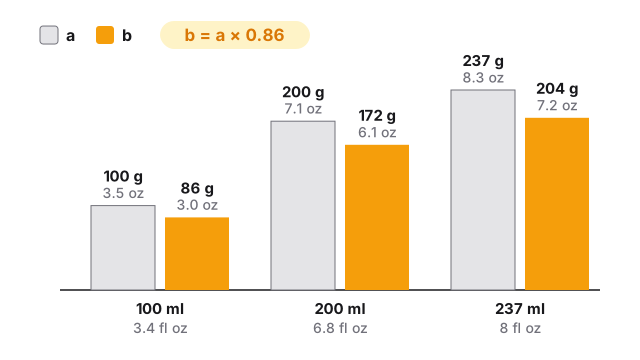
The weight of soy wax a container holds is the weight of water to the fill line multiplied by 0.86. A jar that takes 8 fl oz of water (8.3 oz by weight) holds about 7.2 oz of wax. For whole batches use our soy wax calculator.
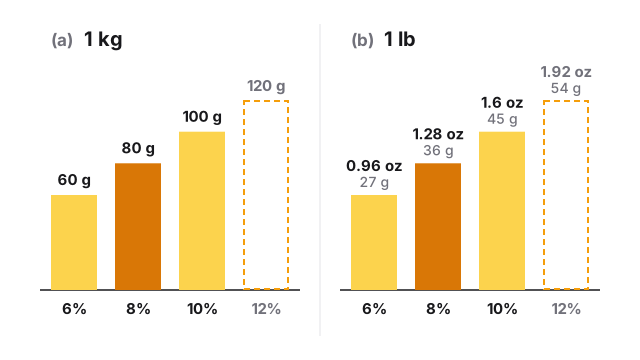
Fragrance oil: 6-10% of wax weight
| Fragrance load | Result | When to use it |
|---|---|---|
| 3-5% | subtle scent, noticeable up close | bedrooms, dinner candles, very strong oils (vanilla, patchouli) |
| 6-8% | clear scent in a 150-200 sq ft room | the standard for most oils and waxes |
| 9-10% | strong throw in larger rooms | lighter oils (citrus, green notes), large candles |
| above 10% | oil sweats out, candle soots and sputters | avoid unless the wax maker explicitly allows 12% |
A fuller discussion, including the differences between oils and a gram/ounce conversion chart, is in how much fragrance oil per pound of wax.
The Complete Wavemade Guide to Natural Candle Making
This guide covers the fundamentals. The ebook has 9 chapters: recipes for specific containers, wick tables, a burn-test protocol and step-by-step troubleshooting.
Dye: less than you think
| Dye type | Amount per 1 lb of wax | Notes |
|---|---|---|
| Liquid candle dye | 2-6 drops | easiest to dose, dissolves instantly |
| Dye blocks / chips | 1/16 to 1/8 of a block (0.5-1.5 g) | shave with a knife, stir for a long time |
| Dye flakes | a pinch (0.2-1 g) | very concentrated, easy to overdo |
| Mica / pigment powders | not for the body of the candle | clog the wick; surface decoration only |
Everything about color, including mixing shades and when to add dye, is in how to dye soy candles.
Wick: sizing by container diameter
| Container diameter | ECO | CD (Stabilo) | Notes |
|---|---|---|---|
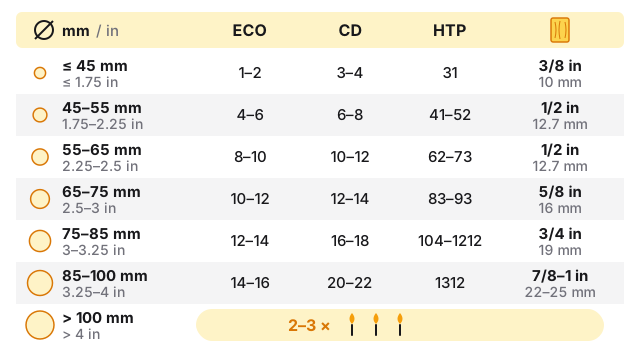
| 1.75-2.25 in (45-55 mm) | ECO 4-6 | CD 6-8 | tea lights, small tins |
| 2.25-2.5 in (55-65 mm) | ECO 8-10 | CD 10-12 | 4-6 oz jars |
| 2.5-3 in (65-75 mm) | ECO 10-12 | CD 12-14 | typical 8-9 oz jars |
| 3-3.25 in (75-85 mm) | ECO 12-14 | CD 16-18 | 12-14 oz jars |
| 3.25-4 in (85-100 mm) | ECO 14-16 or 2 × ECO 8 | CD 20-22 or 2 × CD 10 | consider two wicks |
| over 4 in (100 mm) | 2-3 wicks | 2-3 wicks | one wick will not reach the walls |
Why this is only a starting point, and how to run a burn test to land on the right size, is in our candle wick size chart.
Fill level: half an inch from the rim
Pour so that about half an inch (1 cm) remains between the wax surface and the rim (up to 3/4 inch for containers taller than 4 inches). That margin keeps melted wax from spilling, protects the rim of the glass from overheating, and leaves room if the wick ever runs long. Filling to the brim looks nice on a shelf, but on the first burn the flame sits too close to the glass.
Temperatures: the short version
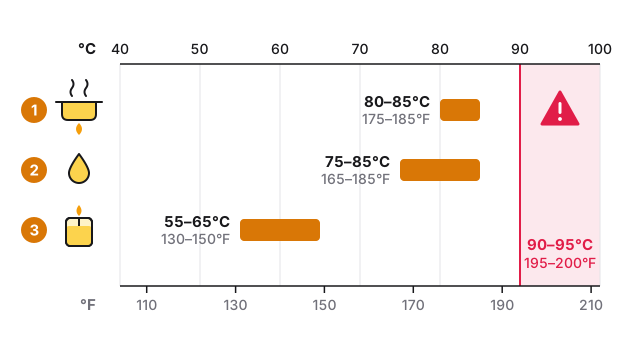
| Stage | Temperature |
|---|---|
| Melting the wax | 175-185°F (80-85°C) |
| Adding dye | 175-185°F, before the fragrance |
| Adding fragrance | 165-185°F (per the wax maker) |
| Pouring | 130-150°F (55-65°C) |
| Containers before pouring | room temperature or gently warmed (100-120°F) |
The full discussion of temperatures by wax, and why they matter so much: what temperature to pour soy wax.
Once the ratios are set, the scent is where candles differ. Our best soy candle fragrance combos list 24 tested blends with exact percentages, and the candle wick sizing guide for containers covers every jar diameter from tea lights to three-wick bowls.
A complete example recipe
The whole process using these numbers, step by step: how to make soy candles.
Frequently asked questions
What is the ratio of soy wax to fragrance oil?
Typically 6-10% fragrance oil by weight of the wax, which is 1 to 1.6 oz per pound. A safe starting point is 8%. The maximum depends on the wax and oil, usually 10-12%.
How much dye do I add to soy wax?
Per pound of wax: 2-6 drops of liquid dye or 1/16 to 1/8 of a dye block. For a single 8 oz jar that is 1-3 drops. Always start low, because the color in liquid wax looks darker than the finished candle.
How high should I fill a candle jar?
About half an inch below the rim. The margin keeps the glass from overheating and stops melted wax from spilling during longer burns.
Are the ratios the same for coconut wax?
Similar but not identical. Coconut blends usually take more fragrance (up to 12%), have a higher wax-to-water ratio (about 0.88-0.9), and often need a smaller wick because they melt more easily.
The Complete Wavemade Guide to Natural Candle Making
9 chapters of tested recipes and troubleshooting techniques - instant digital download, lifetime access to updates.
Read next
Soy Wax Calculator: How Much Wax and Fragrance Oil per Candle
A free soy wax calculator: enter your container size, number of candles, and fragrance load, and get the exact weight of wax and fragrance oil to weigh out. Plus a chart for common jar sizes and where the 0.86 ratio comes from.
5 min readTechniquesHow Much Fragrance Oil per Pound of Wax? 1 oz per lb (6%) and the Full Chart
How much fragrance oil to add to soy wax: a conversion chart for 6, 8, and 10% at common wax weights in ounces and grams, maximum loads by wax, how the type of scent changes the dose, and what happens when you add too much.
5 min readBasicsCandle Wick Size Chart and Calculator: Sizing Guide by Container Diameter for Soy Candles
How to pick a wick for a soy candle: the differences between ECO, CD, HTP, LX, and wood wicks, a size chart by container diameter, what else changes the answer, and a simple burn test that tells you whether your wick is too small or too big.
6 min readBasicsHow Much Soy Wax per Candle? Jar Size Chart and How Many Candles 10 lb Makes
How much soy wax an 8 oz, 12 oz or 16 oz jar really takes, how many candles you get from 1, 5 and 10 pounds of wax, soy wax density and weight-to-volume conversions, and a batch calculator that starts from the wax you already have.
7 min read